Showing posts with label class. Show all posts

Thursday, June 14, 2012

Robert Gober


Since we'll be discussing the role that appropriation plays in the construction of the map and in the history of New York City, it's important to consider work that entertains competing concepts of the appropriated source.  While Mark Bradford uses found material directly in his work, the sculptor Robert Gober fabricates his work differently.  His notes on this piece, Half Stone House, 1979-80, are below:

I moved to New York in 1976, the day after I graduated from college.  I came to New York to find out what being an artist was and what art was and what in the world that meant to me.  I made a living doing all sorts of jobs, from a busboy to carpentry.  One day I decided that I was sick of working for other people, doing work that I really didn't care about and I asked myself a question.  What would I find interesting and entertaining to make, that I could sell, to support myself?  And without in any way belaboring the question, I decided that I would like to make dollhouses.  I was also, during this time, struggling in a self-conscious way to both paint and make objects.  I remember being adamant at the time that the idea of making dollhouses was not about making art.  So I was, in a sense, giving myself a gift by unconsciously choosing my path and came to making art through a back door.  I made a handful of dollhouses and never managed to make any money doing it.  But each house became more complex and more interesting to conceive and construct until I realized that it wasn't dollhouses I was interested in.  What I was drawn to was the house as a symbol.

-From Robert Gober: Sculptures and Installations 1979-2007, ed. by Theodora Vischer.

Wednesday, June 13, 2012

Radical Cartography

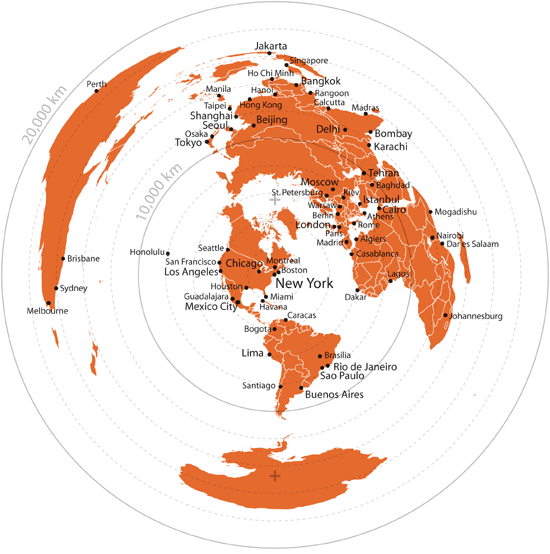
Bill Rankin's site Radical Cartography presents some interesting bridges between the formal resolution of a mapped space and some of its social traits and tendencies.  He also provides some basic vocabulary for the non-geographer to use/appropriate for other practices.  Since we will be engaging projection in the class, this is a useful site to review.  Specific cities are also listed (including New York.)

Radical Cartography

Tuesday, June 5, 2012

Stillspotting NYC at the Guggenheim

In the tradition of Gordon Matta-Clark's Fake Estates project (see the link below for more information), the Guggenheim Museum is sponsoring a project called Stillspotting NYC, a series of site-specific works that directly engage the city as a living map.  Particularly interesting is their emphasis on non-visual ways of mapping the environmental experience.

Here is a link to the Guggenheim site:

Stillspotting NYC

Here is a link to the microsite:

Micro Stillspotting

Here is a link to a Cabinet Magazine article Gordon Matta-Clark's Fake Estates project:

Fake Estates

Two Shows at MoMA

We will be visiting the Museum of Modern Art and there are two exhibitions in particular that you should all keep in mind.  Both are connected in different ways to central premise of the class.  The first, Exquisite Corpses: Drawing and Disfiguration, collects a group of exquisite corpse drawings ranging from the Surrealist movement to the present.  Unfortunately, it ends on July 9th, so if you want to see it, you'll have to go soon after you arrive in town.  Here's a link:

Exquisite Corpses: Drawing and Disfiguration

The second is entitled Ecstatic Alphabets/Heaps of Language and focuses on the role that language and its material and conceptual histories bring to the work shown.  For those of you interested in writing as a component of your studio practice, this is an intriguing show.  It lasts through our stay - ending on August 27th.  The image above the text is a piece from that show by the artist Tauba Auerbach.  Here's a link:

Ecstatic Alphabets/Heaps of Language

For those of you interested in film, it's also worth exploring the MoMA film series calendar - they have an excellent repertory and experimental film series that goes on all year.

Saturday, June 2, 2012

Printed Matter

Printed Matter was founded by artists to celebrate, publish and sell artists' books.  This is an excellent resource - they also have several artist publications, periodicals and zines in the front of the store.  Since it's located in Chelsea, it's a short walk from many of the galleries we'll visit.  Here's a link:

Printed Matter

Friday, June 1, 2012

Land Art and New York City

The relationship between the landscape, the map and the practice of drawing were explored at length in the 1960s and 1970s in the work of the earthworks artists.  This image shows Walter De Maria's Mile Long Drawing, with him in the frame for scale.

These ideas have been revisited in contemporary contexts by several groups - The Center for Land Use Interpretation and the Land Arts of the American West department at Texas Tech University, among others.  I've included both links below.  Both Robert Smithson and Gordon Matta-Clark - members of the original generation of earthworks/conceptual artists from that time - also worked in New York City, providing an interesting collision of separate landscapes.  The Dia Art Foundation, now based in both New York and Beacon, NY, underwrote many of the original projects realized in the American west (and is only a short train ride from the city.)

The Center for Land Use Interpretation

Land Arts of the American West

Dia Art Foundation

Thursday, May 31, 2012

Derive and Psychogeography

Guy Debord and the Situationists were writers, artists and political activists that helped pioneer new ideas in avant-garde artistic practice, particularly in the late 1950s and early 1960s.  Through their interests in mapping, they introduced the concept of derive - an experiential encounter with the landscape based on a kind of real-time response.  The walk you take, for instance, could determine how you respond to it creatively.  Simon Sadler, author of The Situationist City, writes that:

"Maps had traditionally been made by those wishing to impose order upon the city... In their maps, by stark contrast, Debord and Jorn attempted to put the spectator at ease with a city of apparent disorder, exposing the strange logic that lay beneath its surface... the situationist maps described an urban navigational system that operated independently of Paris's dominant patterns of circulation."

It was common for the Situationists to advocate walking through one city using the map of another (similar in some ways to Surrealist games and devices used to reveal unconscious motivations).  The Wikipedia page on derive provides some good background:

Wikipedia - Derive

It's interesting to consider this in the context of Mappr or Wayfaring - how can a map promote an active condition that changes the way we use a space (and doesn't just reflect it?)  Is this something that must happen in the studio, for instance, and not in the real-time mapping process itself?

(Thanks to, and credit for, putting the site comparisons together and for pulling that quote from Simon Sadler must go to the Systeme D blog).

Friday, May 25, 2012

The Brooklyn Rail

Since we'll be spending a lot of our time in Brooklyn, it would be good to get acquainted with The Brooklyn Rail, an independent publication that covers contemporary art among other topics.  It's a good, free resource for non-Manhattan events, openings, etc.  Here's a link to an article that was written on David Humphrey, another artist that we're going to visit with at his studio:

David Humphrey - The Brooklyn Rail

Tuesday, May 22, 2012

Angela Dufresne

Angela Dufresne is one of the artists we will visit in New York.  A link to an interview with her that was published in The Huffington Post is here.

The emphasis on geography and its relationship to history in their conversation is particularly apt considering our emphasis on different ways of mapping/annotating an experience.

Her website is here.

Monday, May 21, 2012

Christopher Wool's East Broadway Breakdown

Christopher Wool has made work that crosses several mediums and disciplines.  His project East Broadway Breakdown was released in book form and collected black and white photographs that he took in New York along Broadway.  From the amazon blurb on the book and project:

"Between 1994 and 1995, Christopher Wool shot a series of photographs in downtown New York City that he calls East Broadway Breakdown, after a street on the Lower East Side, the neighborhood where he lives and works. Taken at night using a 35 mm camera, the pictures feature the city's signature streets with their dilapidated storefronts and ramshackle staircases leading up to anonymous spaces. The high contrast images are often hard to read, producing, rather than coherent images, seemingly random forms that emerge from skewed camera angles. Like his paintings, Wool's photographs hover between abstraction and representation, forcing viewers to confront their desire for visual coherence while offering an alternative construct for picture-making today."

As a model, the work presents an interesting take on how the photograph can be just as useful a notational tool as directly drawing from the landscape, not to mention how choosing one section of the city you engage with every day allows the body of work to tell a larger story by maintaining a site-specific constant.

Sunday, May 20, 2012

Mark Bradford

The artist Mark Bradford's work provides an interesting point of reference for how collage, found materials and painting and drawing techniques can be combined.  Like Anselm Kiefer, the mapped element of the work emerges not just from the way imagery is constructed (such as using forced perspectives and huge sizes), but also from the intensely sculptural relief of the surface.  Here's an interesting write-up on his practice, courtesy of Art 21:

Mark Bradford on Art 21

Thursday, April 12, 2012

Question Assignment

Your second assignment is to go to the FAQ page and post a new question in the comments section of that page.  What do you want to know that we haven't covered?

Materials Wishlist

I have allocated funds in the budget for common materials to be used and shared by the entire class.  What kinds of materials do you think would be useful?  That would you like to experiment with?  Your first assignment is to respond to this post with materials ideas - use the links in the previous post about art materials to research what you can find in New York (you can pretty much find anything, but different places obviously provide different materials.  Feel free to look up other possible sources as well).


The Course - Directed and Individual Projects

A significant portion of this program is studio-based.  Because it is limited to three weeks, the atmosphere will be directed and intense.  The course itself will vary between group studio projects that I will introduce in a drawing context and individually-developed projects that you will pursue.  Like a major studio course, you will be expected to conduct research related to your interests.  Similar to a directed study, you will be encouraged to focus on one or two aspects of this research in order to arrive at a state of completion by the end of the class.  The program will end with a student exhibition at AICAD.

A typical day will include a group exercise followed by individual studio visits.  Each student will have their own studio - they average 10'x18' each, though there are variations to each space.  These studios are your opportunity to bring your primary research from the city into your creative practice.

In order to better prepare for the course itself, I will be posting introductory assignments on this blog, as well as periodically emailing readings and links.